Every Industry is Becoming an AI Industry

Why Does Vespa Exist?

AI is transforming every industry. Search engines are becoming answer engines. Data platforms are becoming AI companies. Commerce is becoming conversational. Media experiences are becoming deeply personalized. Financial services are becoming AI-powered research platforms. Organizations that successfully navigate this shift will redefine how customers discover information, make decisions, and automate work.

This transformation requires more than adopting AI models: it requires rethinking how intelligent applications are built.

We Make AI Work. Vespa exists to make the next generation of AI-native applications possible. Our unified AI Search Platform enables organizations to build intelligent applications that scale predictably, control complexity, and unlock the full value of proprietary data.

Our Design Philosophy

Why are we different?

We build for organizations whose AI applications directly influence revenue, customer experience, and competitive advantage. These applications demand accurate, real-time responses, predictable scalability, and infrastructure costs that remain under control as usage grows.

Our experience building search and recommendation systems at Yahoo shaped a very different approach to AI infrastructure. Long before today's AI search ecosystem emerged, we learned that large-scale search applications cannot depend on fragmented architectures. As AI became another consumer of search, those same architectural principles became even more important. At internet scale, every additional component introduces operational complexity, latency, and infrastructure cost. Those trade-offs may be acceptable for isolated workloads, but they become increasingly difficult to justify as AI becomes central to the application.

Our goal wasn't simply to build the fastest search platform. It was to build one organizations could rely on as AI became central to their business. That's why we built a unified AI Search Platform, bringing retrieval, ranking, machine learning inference, and real-time serving together in a single distributed architecture. The result is a platform that scales predictably, controls infrastructure costs, and evolves as AI advances.

AI is only as useful as the information it can retrieve, understand, and act upon quickly. Vespa was created to make that possible at any scale.
Jon Bratseth,

CEO and founder

Built for Scale From Day One

Why should you trust us?

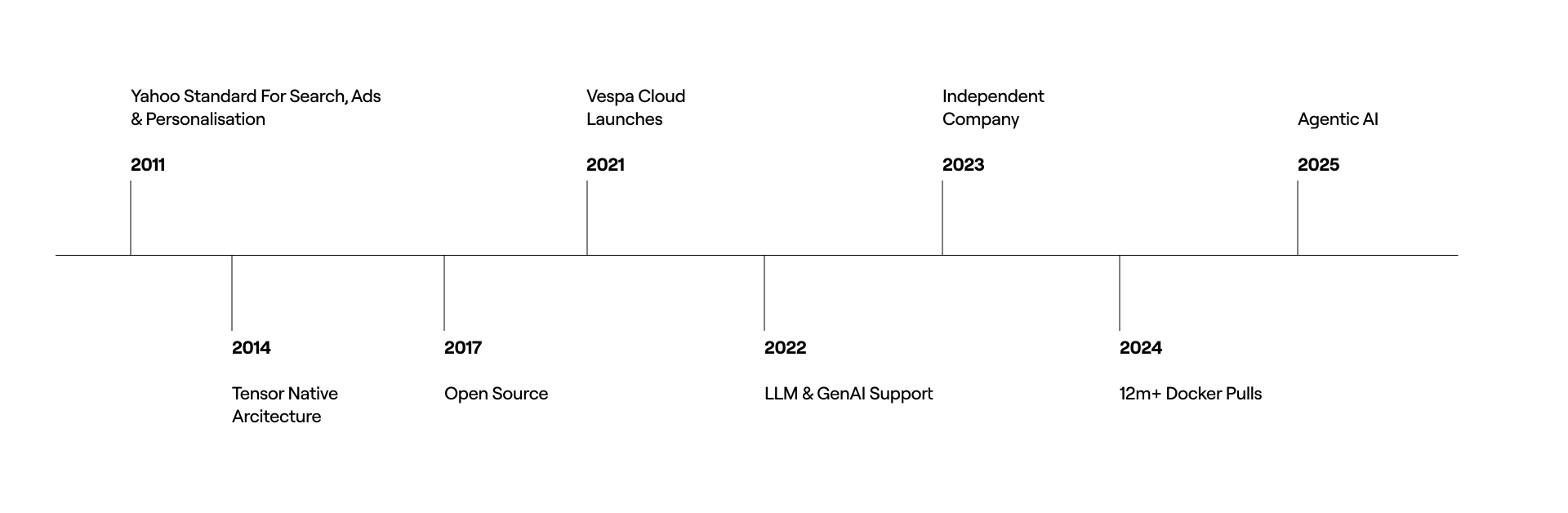
Vespa's architecture traces its origins to the search technology developed at Overture and AltaVista before evolving into the platform Yahoo introduced as Vespa in 2011. Built to power search, advertising, and personalization for some of the world's most demanding customer-facing applications, it has continuously evolved alongside the industry.

Although search applications have changed dramatically—from search and recommendations to answer engines and AI agents—the need to retrieve, rank, and serve the right information efficiently has remained constant. Those same architectural principles continue to underpin today's AI-native applications.

Today, organizations including Yahoo, Perplexity, Spotify, Kleinanzeigen, Taboola, Otto, Etsy, and AlphaSense trust Vespa to power intelligent applications where relevance, latency, and operational efficiency directly influence customer experience and business outcomes.

Available as open source or a fully managed cloud service, Vespa gives organizations complete control over how they build, deploy, and scale AI-native applications.

One Platform. Many AI Applications

What can you build?

The same unified AI Search Platform powers a wide range of intelligent applications. As AI continues to evolve, organizations don't need a different platform for every new capability—they need one platform that evolves with them. Explore these examples.

  • AI Agents

    Provide the retrieval, ranking, and real-time context AI agents need to investigate and act reliably.

  • Answer Engines

    Power trusted, explainable answers over proprietary and public content.

  • Commerce Discovery

    Power intelligent product discovery, recommendations, and personalization.

  • Data Platforms

    Transform proprietary data into AI-native applications.

  • Category icon for the E-book tag

    Media & Advertising

    Deliver personalized content, recommendations, and advertising at scale.

  • Recommendations & Personalization

    Power real-time recommendations and personalization that adapt to every user.

Building Blocks of the AI Search Platform

  • Replace fragmented AI search stacks with a single platform for retrieval, ranking, machine learning inference, and real-time serving—reducing operational complexity while accelerating AI innovation.

  • Support iterative retrieval, reasoning, and multi-step AI workflows over proprietary data without the latency and infrastructure costs of stitched architectures.

  • Combine proprietary content, structured data, operational systems, and external sources through standard APIs and SDKs without duplicating data across multiple search systems.

  • Support hybrid search, vector search, personalization, multimodal search, and RAG from a single search platform that evolves with your AI strategy.

  • Power billions of documents, real-time updates, and thousands of concurrent queries with predictable latency and efficient resource utilization.

  • Deploy on Vespa Cloud with automatic scaling and transparent pricing, or self-manage wherever your architecture requires. Built with enterprise-grade security and governance from the ground up.

Continue Exploring

Explore the architecture, customer success stories, technical resources, and industry solutions that bring Vespa's AI Search Platform to life.

  • Architecture

    Learn how Vespa brings retrieval, ranking, machine learning inference, and real-time serving together in a single distributed architecture.

  • Customer Stories

    See how organizations including Perplexity, Yahoo, Spotify, and Kleinenzeigen use Vespa in production.

  • Performance Benchmarks

    Explore benchmarks for latency, throughput, scalability, and infrastructure efficiency.

  • Industry Solutions

    Discover how organizations are applying Vespa across commerce, media, data platforms, AI agents, and more.

  • Compare Platforms

    Understand how Vespa compares with Elasticsearch, Solr, Pinecone, Weaviate, OpenSearch, and other search technologies.

  • Analyst Perspectives

    Read independent analyst research covering Vespa's architecture, capabilities, and market position.

  • Engineering Blog

    Explore technical deep dives, architecture articles, and best practices from the Vespa engineering team.

  • Partners

    Find implementation and consulting partners with deep Vespa expertise.

  • Category icon for the E-book tag

    Resource Library

    Access white papers, decision briefs, webinars, solution guides, and other resources to help you build AI-native applications.

Frequently Asked Questions

Need more than a quick answer?

If these FAQs don't answer your question, there are several ways to continue:

Learn the fundamentals with our free online training at learn.vespa.ai.

Experience Vespa yourself with a free Vespa Cloud trial.

Watch the Getting Started with Vespa AI Search YouTube video

Contact our team to discuss your application or migration project.
Is AI Retrieval different from Search?
No. AI retrieval builds on decades of search innovation. Traditional search retrieves and ranks information for people to evaluate. AI retrieval retrieves and ranks information for large language models and AI agents to reason over before generating an answer or taking action. The underlying challenge—finding the right information efficiently—remains the same. What's changed is the consumer and the demands placed on the platform.
Why is AI changing search?
Artificial intelligence is changing how organizations build applications and deliver value to customers. Rather than replacing search, AI introduces a new class of applications that retrieve, rank, and act on information at machine speed. Vespa provides the unified AI Search Platform that powers this evolution, combining retrieval, ranking, machine learning inference, and real-time serving within a single architecture.
Why don't we call Vespa a vector database?
Vector search is an important retrieval technique, but modern AI applications require much more than vector similarity. Production systems combine keyword search, structured filtering, ranking, machine learning inference, personalization, and real-time updates. Vespa supports vector search, but it was designed as a unified AI Search Platform that executes the entire retrieval workflow.
Why does Vespa emphasize a unified AI Search Platform?
Many organizations begin their AI journey by assembling multiple specialized technologies. As applications evolve into AI agents and other sophisticated AI workloads, this fragmented approach increases operational complexity, latency, and infrastructure cost. Vespa brings the core capabilities together in a single platform designed to scale as AI applications become more demanding.
What makes Vespa different?
Vespa wasn't created in response to the recent AI boom. It was developed at Yahoo to solve large-scale search, ranking, and personalization challenges long before generative AI became mainstream. Those same architectural principles continue to underpin today's AI-native applications.
Is Vespa only for large organizations?
No. Vespa powers some of the world's largest AI applications, but the same architecture is available as open source or through Vespa Cloud. Organizations can start small and scale as their applications grow without changing platforms.
What kinds of applications is Vespa designed for?
Vespa powers AI agents, answer engines, commerce discovery, recommendations, media and advertising platforms, and AI-native data platforms. The common requirement is intelligent retrieval over proprietary data with predictable performance at scale.
Why is proprietary data so important?
Public AI models are trained on publicly available information. Competitive advantage increasingly comes from combining those models with proprietary data, domain expertise, and business context. Vespa helps organizations retrieve, rank, and serve that information efficiently.
Does Vespa have anything to do with scooters?
No. The Vespa AI Search Platform originated as a search platform developed within Yahoo, where it became known as VESPA. When the company became independent in 2023, the project name was adopted as the company name. The name is unrelated to any scooter brand.
Built by engineers with more than a decade of solving large-scale search and AI retrieval challenges. We'd love to help you solve yours.

Ready to Build the Next Generation of AI-Native Applications?

Every industry is becoming an AI industry. Whether you're modernizing an existing platform or building something entirely new, let's discuss your architecture, answer technical questions, and explore how Vespa can help.