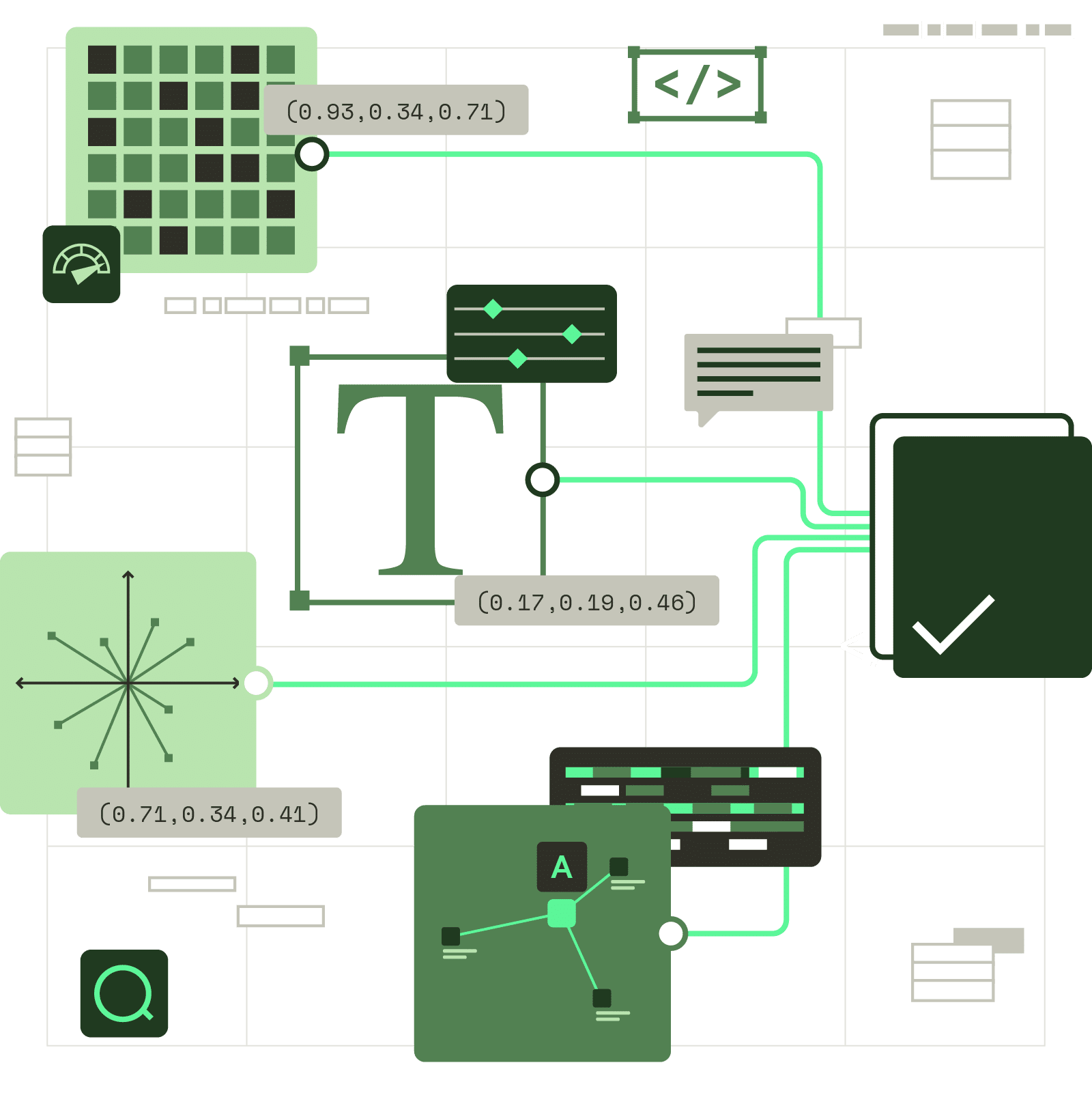
Inside the Vespa AI Search Platform

Learn how Vespa executes the complete AI retrieval workflow within a single distributed architecture, bringing retrieval, ranking, machine learning inference, and real-time serving together for high-performance AI applications.

How the AI Search Platform Works

This page explains how the Vespa AI Search Platform executes the complete AI retrieval workflow. It introduces the platform's core architectural concepts and links to the technical deep dives that explore each capability in more detail.

Vespa is designed around a simple architectural principle: execute the AI retrieval workflow where the data lives. Rather than moving data between specialized systems for retrieval, ranking, inference, and serving, Vespa performs these operations within a unified distributed engine, reducing network overhead while improving latency, scalability, and operational simplicity.

Vespa is a distributed serving engine that unifies retrieval, ranking, machine learning inference, and real-time serving within a single architecture. Rather than stitching together specialized databases, retrieval engines, inference services, and serving infrastructure, Vespa executes the entire AI retrieval workflow close to the data, delivering high throughput, predictable latency, and operational simplicity at scale.

architecture

Platform Architecture

Understand the distributed architecture that executes the AI Retrieval Workflow. Here you'll find the core platform components that power retrieval, ranking, machine learning inference, and real-time serving.

Introduction

Vespa is built from a set of integrated architectural components that work together to execute the complete AI retrieval workflow. Rather than treating each stage of the retrieval workflow as a separate system, the components are designed to operate within a unified distributed architecture.

The following sections introduce the platform's core building blocks and explain how they contribute to scalable, real-time AI retrieval. Each topic links to a technical deep dive for a more detailed architectural discussion.

Unified Data Model

Vespa brings structured data, full text, vectors, and tensors together into a single document model. Rather than storing different data types in separate systems and combining results later, applications can model, index, and retrieve them through a single schema and query pipeline.

This unified approach simplifies application architecture while enabling lexical search, semantic retrieval, filtering, ranking, and machine learning to work together over the same data.

Document Model & Index Structure

Vespa brings structured data, text, vectors, and tensors together in a single document model.

Distributed Serving

Vespa distributes data across independent content nodes and executes retrieval, ranking, and machine learning inference where the data already resides. Rather than moving large volumes of data across the network for processing, queries are executed locally before results are combined into a final response. This minimizes network overhead while delivering high throughput, predictable latency, and efficient resource utilization as applications scale.

This shared-nothing architecture enables parallel query execution, local model inference, and linear scalability, making Vespa well-suited for large-scale AI applications where retrieval quality, response time, and availability directly affect user experience and business outcomes.

Distributed Architecture & Scaling

Learn how Vespa distributes data and executes queries across independent content nodes.

Vespa executes the complete AI Retrieval Workflow within a unified distributed architecture, keeping computation close to the data for efficient, low-latency execution at scale.

Retrieval Pipeline

Vespa supports a flexible retrieval pipeline that combines multiple retrieval techniques within a single query. Rather than relying on a single search method, applications can combine lexical search, vector search, filtering, and candidate generation to retrieve the most relevant information for each query.

This unified pipeline provides the foundation for modern AI retrieval, enabling hybrid search, retrieval-augmented generation (RAG), recommendations, and personalized search without requiring separate retrieval systems. Queries can be progressively refined before passing candidates to the ranking stages, balancing retrieval quality with efficiency.

Hybrid Retrieval Pipeline

Combine lexical, vector, filtering, and structured retrieval within a single query.

Multi-Phase Ranking

Retrieval identifies candidate documents. Ranking determines which of those candidates are most relevant. Vespa uses a multi-phase ranking pipeline that progressively applies increasingly sophisticated ranking models, allowing applications to improve relevance while controlling computational cost and query latency.

Each ranking stage can combine lexical signals, semantic similarity, business rules, personalization, and machine learning models, ensuring that expensive computations are performed only on the most promising candidates.

Advanced Ranking & Relevance

Progressively improve relevance by combining lexical signals, semantic similarity, business rules, personalization, and machine learning within an efficient ranking pipeline.

Machine Learning Inference

Vespa executes machine learning models directly within the retrieval pipeline, allowing inference to occur alongside retrieval and ranking rather than through separate model-serving infrastructure. This enables applications to enrich queries, rerank results, and execute machine learning inference without introducing additional network hops.

Vespa supports industry-standard model formats such as ONNX, as well as XGBoost models, custom ranking functions, and transformer-based rerankers, including cross-encoders. Executing inference close to the data reduces latency while simplifying the overall AI architecture.

Machine Learning & Model Inference

Execute ONNX models, XGBoost, cross-encoders, and custom ranking functions directly within the retrieval pipeline for low-latency AI inference.

Real-Time Updates

Modern AI applications depend on continuously changing information, from new documents and inventory changes to user interactions and behavioral signals. Vespa is designed for real-time serving, making newly ingested content and updates searchable almost immediately while maintaining predictable low-latency query performance.

Support for partial document updates enables individual fields to be modified without rebuilding entire documents, while the distributed architecture efficiently handles high ingestion rates alongside query traffic. This allows applications to maintain fresh retrieval results even as data changes continuously.

Real-Time Indexing & Partial Updates

Keep search results continuously up to date with real-time indexing, partial document updates, and immediate query visibility.

deployment

Deployment & Operations

Understand how Vespa applications are deployed and operated in production. Here you'll find the deployment models, infrastructure options, and scaling capabilities needed to run AI retrieval systems at any scale.

Application Deployment Model

Vespa is designed to run consistently across development, testing, and production environments. Applications are packaged as self-contained deployments that include document schemas, ranking logic, machine learning models, and configuration, allowing the entire retrieval stack to be versioned and deployed as a single unit.

Whether running on-premises, in Kubernetes, or on Vespa Cloud, the same application model simplifies deployment, upgrades, and operational management while ensuring consistent behavior across environments.

Deploy Vespa

Package schemas, ranking logic, machine learning models, and configuration into a single deployable application.

Multi-Cluster Architecture

Large-scale AI applications often have different datasets, workloads, or latency requirements. Vespa allows a single application to span multiple content clusters, enabling each dataset to be indexed, scaled, and optimized independently while remaining part of a unified retrieval platform.

This architecture supports use cases such as separating public and private data, streaming and indexed workloads, or regional datasets without requiring multiple independent deployments.

Deploy Multi-Cluster

Run multiple datasets and workloads within a single Vespa application while scaling and optimizing each cluster independently.

Multi-Cloud

Vespa can be deployed across public cloud providers, private infrastructure, and hybrid environments using the same application model. This gives organizations the flexibility to deploy retrieval workloads where it makes the most operational or regulatory sense without changing application logic.

The consistent deployment model also simplifies migration, disaster recovery, and global expansion while avoiding unnecessary infrastructure lock-in.

Deploy Multi-Cloud

Deploy the same Vespa application across public cloud, private infrastructure, and hybrid environments using a consistent application model.

Scaling

Vespa is designed to scale horizontally by distributing both data and query execution across independent nodes. Storage capacity, indexing throughput, and query performance can be increased by adding resources, allowing applications to grow without fundamental architectural changes.

This elastic architecture allows applications to scale from small deployments to globally distributed AI systems that serve billions of documents and millions of users without a fundamental architectural redesign.

Scale Vespa
Deploy the same Vespa application across public cloud, private infrastructure, and hybrid environments using a consistent application model.

  • The RAG Blueprint

    A modular application template for designing, deploying, and testing production-grade RAG systems.

    Read more
  • Visual Retrieval

    Enhance multimodal search by combining image and text queries for more comprehensive results.

    Read more
  • Chunking

Learn with Vespa

Learn how to build search, recommendation, and RAG applications with Vespa through a free, self-paced course that combines hands-on exercises with links to the documentation.

Ready to Build Your AI Retrieval Workflow?

Whether you're evaluating Vespa Cloud or planning a self-managed deployment, we'd be happy to discuss your architecture, answer technical questions, and help you get started.