Search is Entering a New Era
Search applications have continuously evolved as new retrieval techniques emerged. Keyword retrieval was joined by machine-learned ranking, personalization, semantic retrieval, and recommendation systems. Many organizations adopted these capabilities by integrating specialized search engines, ranking services, and machine learning components into their existing architectures.
AI changes the demands placed on search.
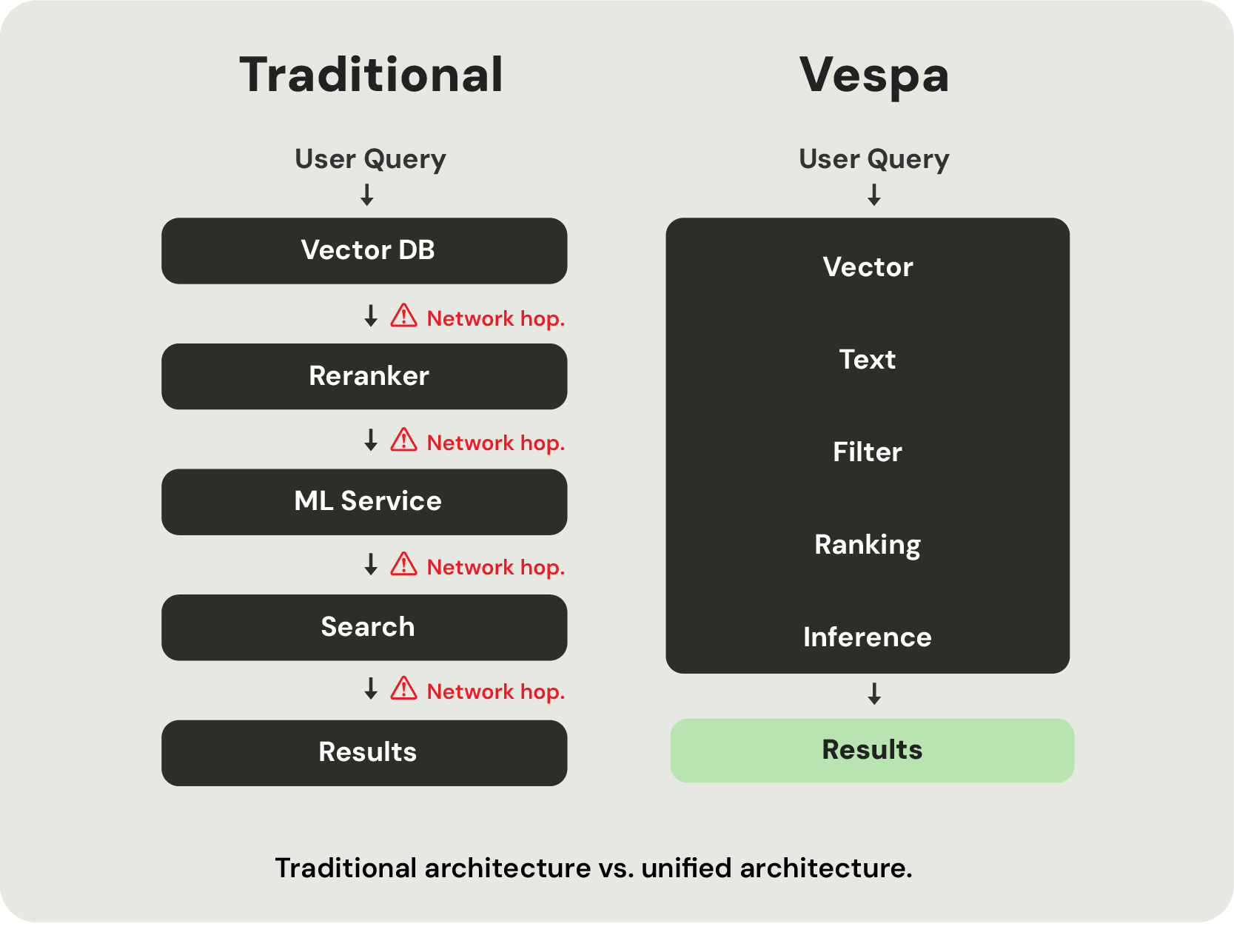
Large language models (LLMs) and AI agents dramatically increase both the volume and sophistication of retrieval. What was once a manageable search architecture becomes a complex retrieval workflow in which every additional component increases latency, operational complexity, and infrastructure costs.
Traditional search could often tolerate fragmented architectures because humans compensated for imperfect retrieval by refining queries or selecting a better result. AI retrieval cannot. Every retrieval becomes part of an automated workflow, in which the quality of the final answer depends entirely on the retrieved context.
As search evolves to support both people and AI systems, the retrieval workflow becomes the defining engineering challenge.