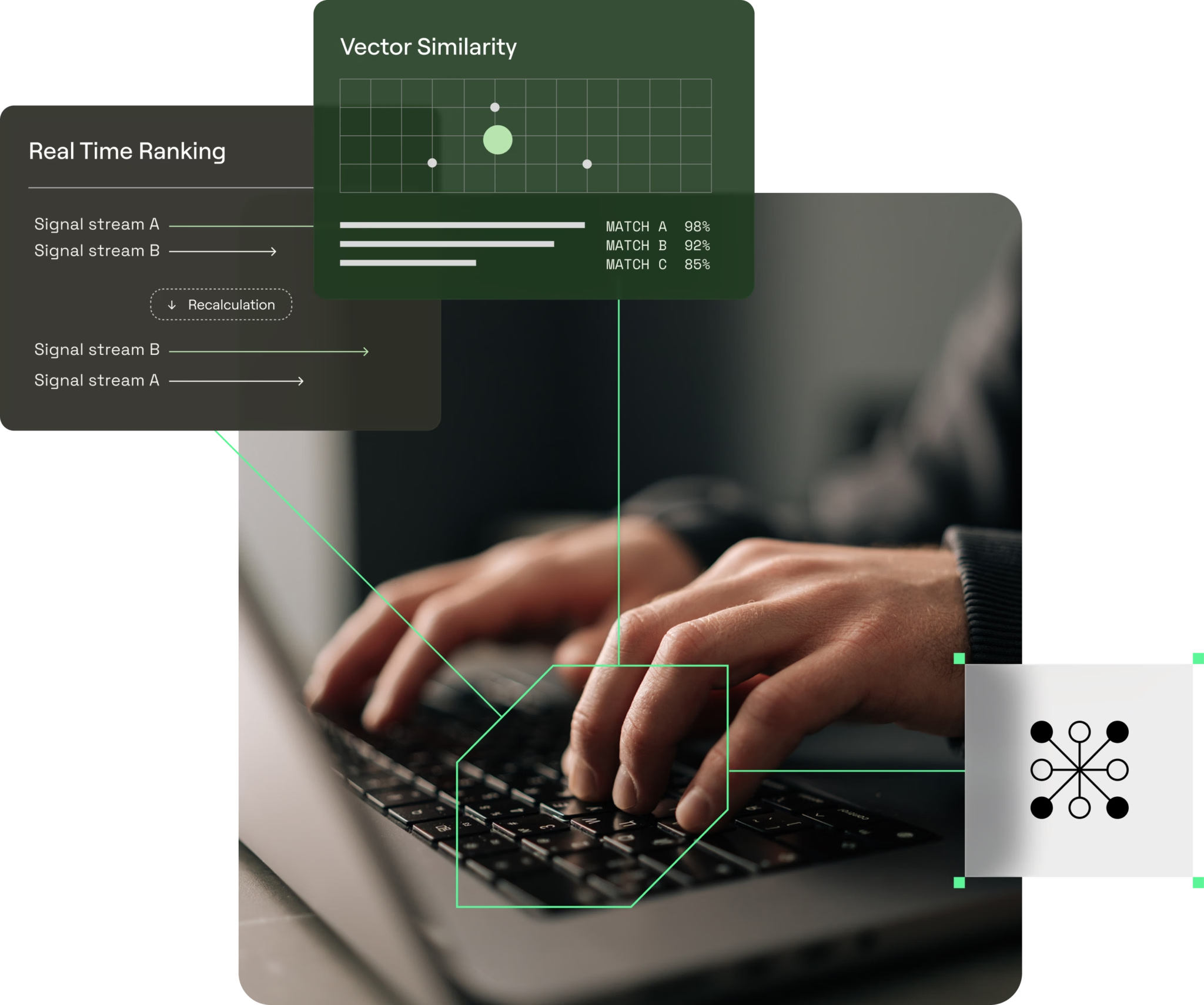
Industry Trend

Real-Time AI is Raising the Bar

Life Sciences organizations generate some of the world's most valuable knowledge, but also some of its most complex data.
Scientific publications, genomic data, molecular structures, laboratory results, clinical studies, patents, microscopy, and medical imaging all contribute to the discovery process. Researchers increasingly expect AI systems that can analyze this information, integrate evidence from multiple sources, and accelerate scientific discovery.

As AI assistants and autonomous research agents become part of everyday scientific workflows, retrieval quality has become a critical differentiator. The challenge is no longer simply finding documents, but retrieving the right evidence, ranking it appropriately, and providing trusted context for AI reasoning.

opportunity

The AI Opportunity

AI transforms how researchers discover knowledge, investigate evidence, and accelerate scientific discovery. Modern research workflows increasingly rely on AI to retrieve trusted context from vast collections of scientific literature, molecular data, clinical evidence, and proprietary research.

  • Multimodal data becomes the norm

    Life Sciences organizations must retrieve and connect information across publications, genomic data, protein structures, laboratory results, patents, medical images, and structured research data. AI applications increasingly need to reason across these diverse data types within a single retrieval workflow.

  • Retrieval becomes more sophisticated

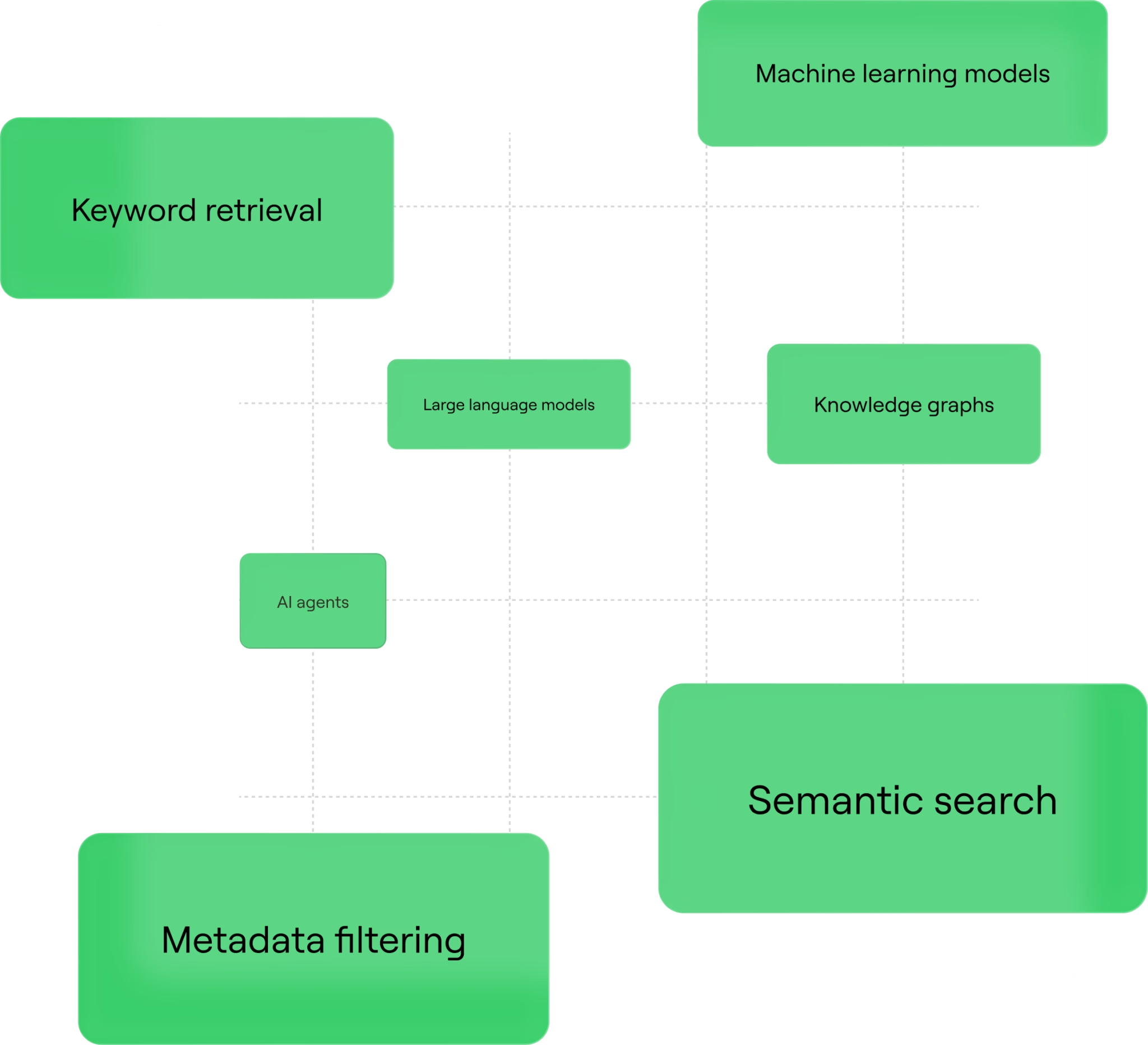
    Scientific AI requires far more than semantic similarity. Modern retrieval combines keyword search, vector similarity, metadata filtering, knowledge graphs, machine learning, and domain-specific ranking to surface the most relevant evidence for researchers and AI assistants.

  • Scientific knowledge changes continuously

    New publications, experimental results, clinical studies, and proprietary research constantly expand the available evidence. AI applications must continuously incorporate new knowledge without disruptive rebuilds or stale indexes.

  • AI serving costs continue to grow

    As AI assistants perform increasingly complex investigations over scientific knowledge, retrieval, ranking, and inference consume significantly more compute. Efficiently executing the AI retrieval workflow is becoming essential for controlling infrastructure costs while maintaining scientific accuracy.

Cost

The Cost of AI Search at Scale

Scientific AI places enormous demands on retrieval infrastructure.
Research applications frequently combine semantic search, keyword retrieval, metadata filtering, machine learning models, knowledge graphs, and large language models within a single workflow. As AI agents perform increasingly sophisticated investigations, these retrieval pipelines become even more complex.
Many organizations assemble this capability from multiple specialized systems—vector databases, search engines, databases, inference services, and orchestration frameworks.
The result is growing infrastructure complexity, duplicated data pipelines, higher operational costs, and increasing latency exactly where researchers need fast, reliable answers.

Defeating the Integration Tax

According to GigaOm's CIO Decision Brief, organizations consolidating fragmented AI search stacks can achieve:

  • Up to 5× lower infrastructure costs through a unified AI Search Platform.
  • Recovery of engineering capacity, redirecting teams from maintaining synchronization pipelines to building new AI capabilities. GigaOm estimates that reclaiming just three engineers represents over $540K per year in recovered engineering investment.
  • Fewer vendor relationships and simpler procurement by replacing multiple AI search components with a single platform.

The next generation of scientific AI requires more than isolated AI components. Vespa brings retrieval, ranking, machine learning, and real-time serving together within a single AI search platform that supports a broad range of Life Sciences applications.

Choose Vespa When

Choose Vespa when you need to:

  • Build AI-native Life Sciences research platforms.
  • Search scientific literature, molecular data, structured research data, and multimodal content together.
  • Power AI research assistants over proprietary scientific knowledge.
  • Continuously ingest new publications and experimental results.
  • Support complex ranking beyond vector similarity.
  • Reduce the infrastructure complexity of large-scale AI retrieval.

Organizations building AI assistants such as Perplexity depend on Vespa to retrieve and rank trusted context from massive knowledge collections. The same retrieval capabilities enable researchers and AI assistants to investigate scientific knowledge with greater depth, accuracy, and confidence.

Why Vespa

One Platform. Every AI Search Capability

Life Sciences AI demands far more than vector search.

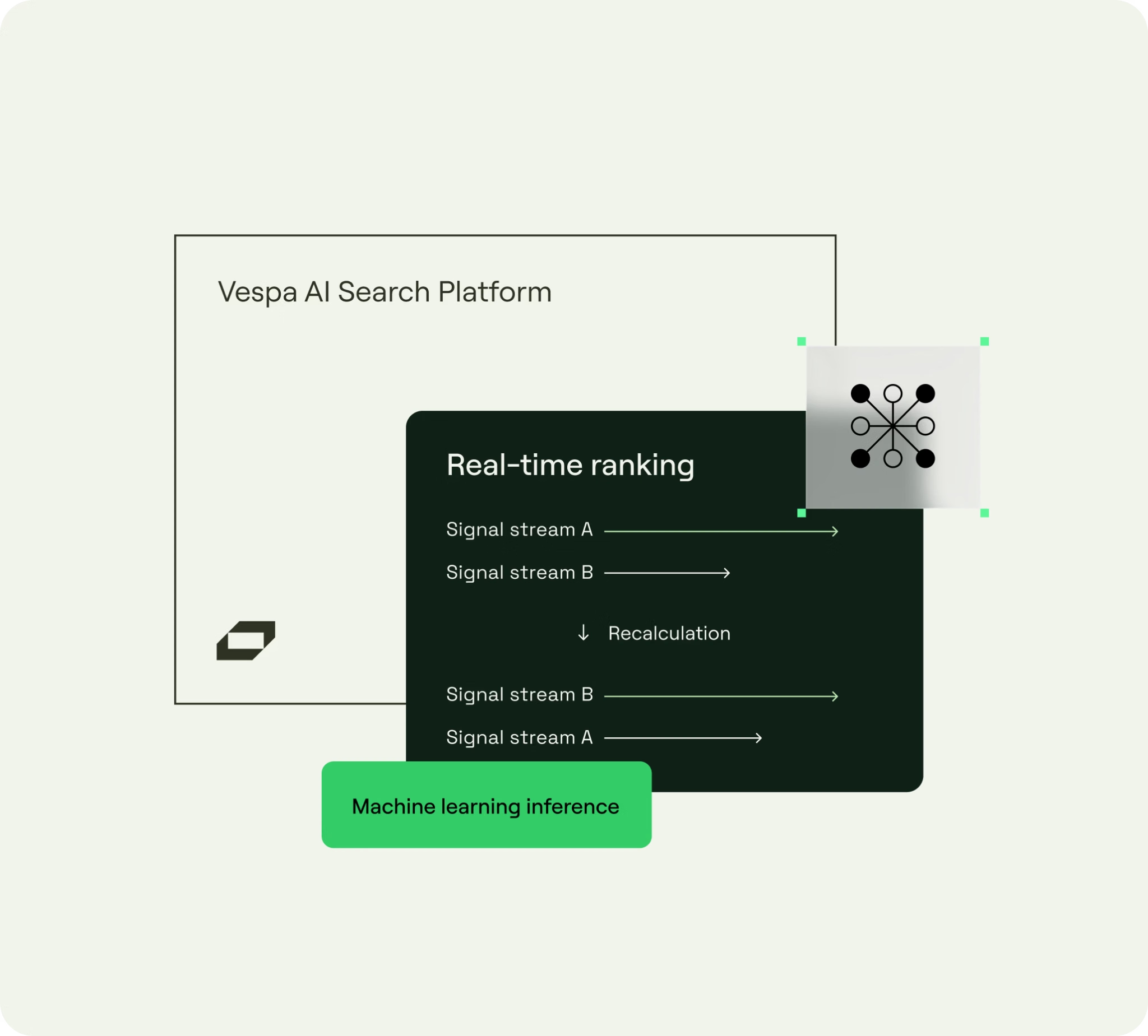
Vespa combines hybrid retrieval, advanced ranking, machine learning inference, and real-time serving within a unified distributed architecture. Instead of stitching together specialized systems, organizations can build AI-native research platforms on a single foundation that scales from scientific search to autonomous AI agents.

Vespa Powers AI Across the Life Sciences

Organizations across the Life Sciences are applying AI to accelerate scientific discovery, improve research productivity, streamline regulatory processes, and support commercial decision-making. Although these applications solve different problems, they share a common requirement: retrieving and ranking trusted scientific knowledge across structured, unstructured, and multimodal data.

Vespa provides a common AI search platform that powers applications including:

  • Scientific knowledge discovery
  • AI research assistants
  • Drug discovery and target identification
  • Clinical trial matching
  • Molecular and protein search
  • Biomarker discovery
  • Clinical research
  • Real-world evidence analysis
  • Regulatory intelligence
  • Commercial content creation

Rather than deploying separate infrastructure for each application, organizations can build multiple AI capabilities on a single platform that combines retrieval, ranking, machine learning, and real-time serving.

Modern Life Sciences AI increasingly relies on multidimensional data representations to model complex biological relationships. Learn how tensors enable multimodal search, ranking, and machine learning across Life Sciences applications.

Why Leading Life Science Companies Choose Vespa

  • Search publications, structured datasets, embeddings, molecular metadata, and multimodal content within a single query.

  • Continuously index newly published papers, research datasets, laboratory results, and experimental observations without disruptive rebuilds.

  • Support embeddings, tensors, images, and structured scientific data within the same retrieval workflow, enabling modern multimodal AI applications.

  • Combine semantic similarity with citations, publication quality, recency, metadata, experimental signals, and machine-learned ranking models.

  • Power large-scale AI applications with predictable latency across billions of documents and vectors.

  • Execute ONNX ranking and inference models directly during retrieval to improve scientific relevance without external serving infrastructure.

Ready to Simplify Scientific AI Infrastructure?

Life Sciences organizations are moving beyond isolated AI experiments toward AI-native research platforms that continuously retrieve, rank, and reason over proprietary scientific knowledge.Learn how Vespa simplifies the architecture behind modern scientific AI while reducing infrastructure complexity and supporting the next generation of research applications.

FAQ

Need more than a quick answer?

If these FAQs don't answer your question, there are several ways to continue:

Learn the fundamentals with our free online training at learn.vespa.ai.

Experience Vespa yourself with a free Vespa Cloud trial.

Watch the Getting Started with Vespa AI Search YouTube video

Contact our team to discuss your application or migration project.
Why is retrieval important for Life Sciences AI?
AI is only as effective as the information it retrieves. Life Sciences organizations must search across scientific literature, molecular data, clinical studies, laboratory results, and proprietary research to provide AI with accurate, relevant context. High-quality retrieval helps researchers and AI assistants investigate complex scientific questions with greater confidence while reducing hallucinations and improving the quality of AI-generated insights.
Can Vespa search both scientific literature and structured research data?
Yes. Vespa combines keyword search, semantic search, metadata filtering, and structured retrieval within a single query. This allows researchers to search scientific publications alongside structured datasets, molecular information, experimental results, and other proprietary research without maintaining separate search systems.
Does Vespa support multimodal biomedical search?
Yes. Modern Life Sciences AI increasingly combines text, structured data, vectors, images, and machine learning embeddings within the same application. Vespa supports multimodal retrieval by enabling these different data types to be indexed, searched, and ranked together, making it well suited for applications such as scientific literature search, molecular discovery, and biomedical image retrieval.
How does Vespa differ from a vector database?
Vector databases specialize in similarity search over embeddings. Vespa provides a complete AI search platform that combines vector search with keyword search, structured retrieval, metadata filtering, advanced ranking, machine learning inference, and real-time serving. This enables organizations to build production AI applications without assembling multiple specialized systems.
Can Vespa support AI research assistants?
Yes. AI research assistants depend on retrieving trusted scientific context before generating responses or recommendations. Vespa provides the retrieval, ranking, and real-time serving needed to ground large language models in scientific literature, proprietary research, and structured data, helping AI assistants deliver more accurate and trustworthy answers.
How does Vespa reduce infrastructure complexity?
Many AI search architectures combine separate vector databases, search engines, machine learning services, and data pipelines. Vespa brings hybrid retrieval, advanced ranking, machine learning inference, and real-time serving together within a single distributed platform. This simplifies deployment, reduces operational overhead, and helps organizations control AI infrastructure costs while supporting multiple Life Sciences applications on the same foundation.

Accelerate AI-Driven Scientific Discovery

Whether you're building AI research assistants, scientific search platforms, or large-scale retrieval systems for Life Sciences, we'd be happy to discuss your architecture, answer technical questions, and help you build the next generation of AI-native research applications.