What you can build

Three application families. Many business possibilities.

Applications built on Vespa serve a wide range of needs, from finding products and recommending content to investigating complex questions and generating grounded answers.

Three common application families share the same foundation: retrieving eligible information, evaluating its relevance, and serving the most useful results. A single application can combine search, recommendations, and AI retrieval to support different user needs.

find relevant information

Search and discovery.

Help people find relevant products, content, and information.

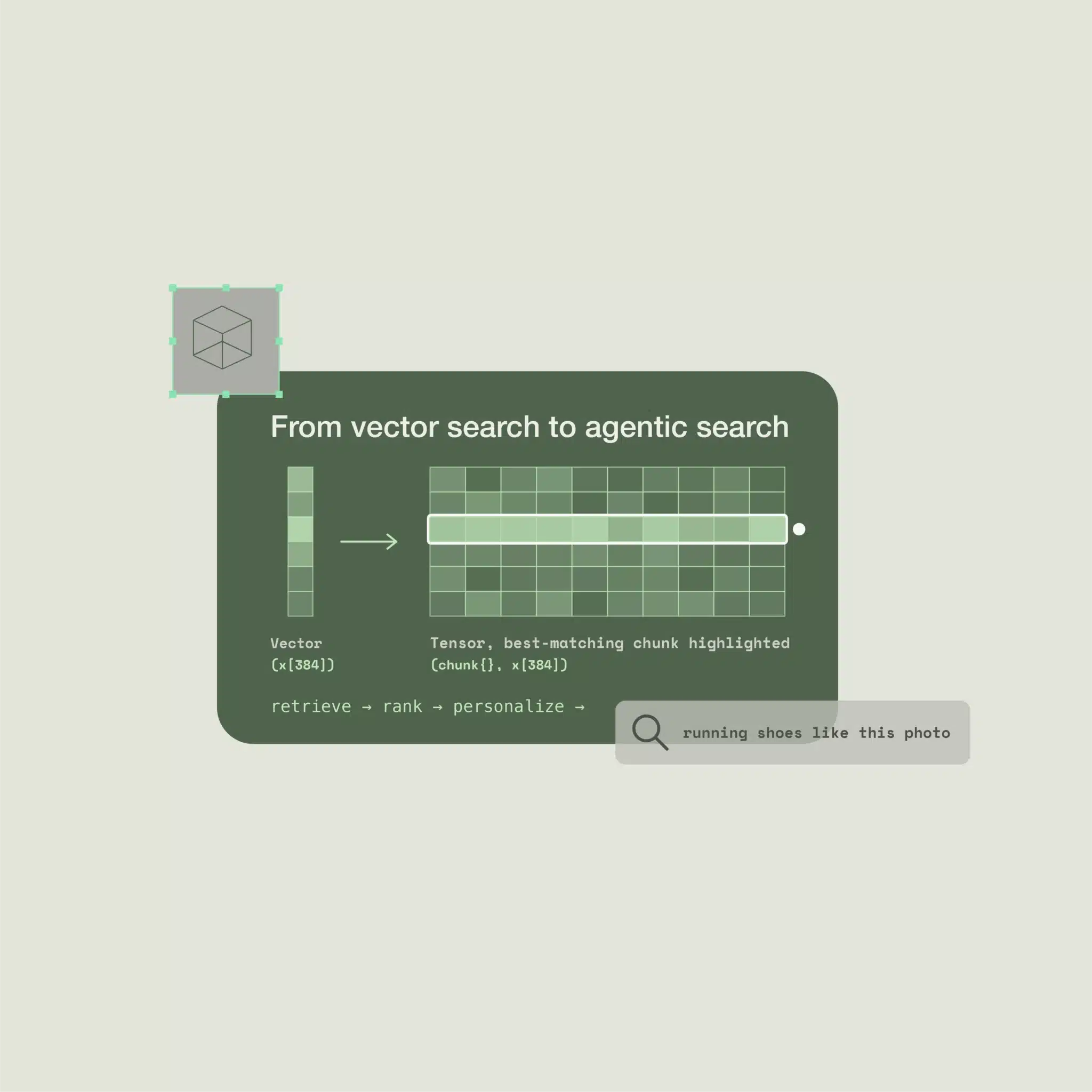
Search applications need to interpret the intent behind a user’s query while recognizing details that must match exactly. Vespa combines text search, vector similarity, and structured filters with programmable ranking to select relevant results.

Applications such as product discovery also combine search and recommendations with structured navigation. Shoppers may search with words or images, browse categories, and narrow results by size, color, merchant, or availability. Vespa supports these interactions through a common retrieval and ranking framework.

Supporting capabilities
Hybrid retrieval: Combine keyword matching, vector similarity, and structured constraints within a query.
Programmable relevance: Use text-match features, embeddings, business signals, and machine-learned models to rank results.
Navigation and presentation: Support faceting, grouping, aggregation, dynamic snippets, and match highlighting.
Language and query processing: Interpret text through linguistic processing and matching approaches suited to the application.
Personal and tenant-scoped search: Use streaming search when queries target a user’s or tenant’s data, allowing direct search of that subset without maintaining search indexes.
Example business applications
These search and discovery applications are running today in organizations using Vespa.

Financial research: Find and rank relevant intelligence across reports, news, and proprietary datasets.
Marketplace discovery: Help shoppers find relevant products across large, rapidly changing catalogs.
Job and talent discovery: Combine skills, experience, preferences, and eligibility requirements to surface relevant opportunities.
Evidence-based advocacy: Make verified information easier to find, investigate, and use.
Code samples

SELECT WHAT MATTERS

Recommendation and personalization.

Select relevant items using user, behavioral, and contextual signals.

Recommendation, personalization, and advertising applications combine retrieval of eligible content with machine-learned model evaluation to select useful items for each person or situation.

Vespa combines filtering with ranking and model inference close to the stored content. Applications can incorporate preferences, recent behavior, location, time, and other signals, while updates allow changing information to influence subsequent results.

These capabilities support product recommendations, personalized feeds, content discovery, job matching, and advertisement selection. They can also personalize search results within a broader discovery experience.

Supporting capabilities
Candidate eligibility: Apply structured conditions to determine which items can be recommended.
Personalized ranking: Combine stored item features with user and contextual inputs supplied at query time.
Live signals: Update behavioral and business information through partial document updates.
Multi-phase evaluation: Apply increasingly sophisticated ranking models to progressively smaller candidate sets.
Related information: Incorporate shared signals through document relationships, such as advertisements associated with campaigns.
Example business applications
These recommendation and personalization applications are running today in organizations using Vespa.

Personalized content discovery: Match listeners and readers with relevant content using their interests, behavior, and current context.
Marketplace recommendations: Surface products that align with shoppers’ interests and tastes across changing catalogs.
Advertising relevance: Select and rank eligible advertisements using search intent, user context, and campaign requirements.
Catering recommendations: Match customers with providers based on location, availability, menus, reputation, and event requirements.
Code samples

EVIDENCE FOR AI WORKFLOWS

AI answers and agents.

Supply relevant, current evidence throughout AI workflows.

Generative AI applications often need proprietary, specific, and recent information beyond the model’s training data. The usefulness of their answers depends on the relevance of the evidence retrieved for them.

Retrieval-augmented generation (RAG) connects models with that evidence. Agents extend the workflow by searching repeatedly as they investigate questions, compare alternatives, and decide what to do next.

Vespa combines hybrid retrieval, multi-vector representations, structured filtering, and machine-learned ranking to select information for these tasks. Applications can also use it as a shared context-serving layer, making enterprise knowledge and agent-generated findings searchable across workflows.

Supporting capabilities
Evidence retrieval: Combine exact terminology, semantic similarity, and structured constraints to find relevant information.
Passage selection and reranking: Refine candidate results and select useful passages from larger information collections.
Current information: Make new content and updated fields available to subsequent searches.
Agent retrieval controls: Expose tested query and ranking strategies through APIs for agents and frameworks to invoke.
Model integration: Return selected evidence to the application’s model workflow or integrate model calls into request processing.
Example business applications
These AI answer and agent applications are running today in organizations using Vespa.

AI answer engines: Retrieve and rank relevant information from large collections to support trustworthy AI-generated answers.
Research assistants: Help researchers find and synthesize relevant evidence across specialist information collections.
Investment research agents: Retrieve and connect institutional knowledge across documents and systems to inform investment decisions.
Sales intelligence agents: Identify potential enterprise buyers within developer communities and support relevant engagement.
Code samples

Retrieval at work

One platform. Many ways to put retrieval to work.

The same retrieval and ranking capabilities support very different business applications. These examples illustrate how organizations can apply Vespa to their information, users, and operating requirements.

  • AI agents

    Investigate questions and complete tasks using relevant, current evidence.

  • Answer engines

    Generate answers grounded in proprietary and public information.

  • Advertising relevance

    Retrieve eligible advertisements and rank them using intent, context, campaign information, and other relevance signals.

  • Product discovery

    Help shoppers find products through search, recommendations, and personalization.

  • Information platforms

    Help users discover, connect, and synthesize specialist information.

  • Content discovery and personalized feeds

    Match people with relevant articles, podcasts, creators, and communities.

  • Financial and investment research

    Retrieve and rank relevant intelligence across reports, news, and proprietary knowledge to support research, comparisons, and AI-assisted investigation.

  • Content discovery & personalized feeds

    Match people with relevant articles, podcasts, creators, and communities using their interests, behavior, and current context.

  • Job and talent matching

    Combine skills, experience, preferences, and eligibility requirements to connect candidates with relevant opportunities.

BUILD TODAY. EXTEND TOMORROW.

One retrieval foundation. Evolving applications.

These applications do not have to develop in isolation. A retailer might begin with product search, add personalized recommendations, and later introduce conversational shopping or an agent that compares alternatives.

An information provider might start with document search, then add generated answers and research agents over the same proprietary collection.

Vespa provides a common retrieval and ranking foundation that teams can extend as their requirements evolve. Retrieval methods, ranking models, and application signals can change while continuing to use the platform’s serving capabilities.

See how customers put Vespa to work

Explore customer stories showing how teams apply retrieval and ranking to search, recommendations, and AI applications—and the requirements their implementations address.

Frequently asked questions

Need more than a quick answer?

If these FAQs don't answer your question, there are several ways to continue:

Learn the fundamentals with our free online training at learn.vespa.ai.

Experience Vespa yourself with a free Vespa Cloud trial.

Watch the Getting Started with Vespa AI Search YouTube video

Contact our team to discuss your application or migration project.
What applications can I build with Vespa?
Vespa supports three broad application families: search and discovery, recommendations and personalization, and retrieval for AI answers and agents. These capabilities power applications such as marketplace discovery, financial research, personalized content feeds, advertising, and research assistants. A single product can combine several of these patterns.
How do search, recommendations, and AI retrieval work together?
They share a common workflow: retrieve eligible information, evaluate its relevance, and return useful results. The inputs and ranking strategies differ. Search responds to a query, recommendations use signals about a person or situation, and AI retrieval supplies evidence for a model or agent. Vespa lets applications combine these approaches within one platform.
Is product discovery a search or recommendation use case?
It can include both. Shoppers may search for a specific item, browse categories, or discover products through recommendations. Personalization can influence each experience, while structured filters enforce requirements such as size, price, and availability. Vespa supports these interactions through a common retrieval and ranking framework.
Does Vespa build AI agents or provide the retrieval infrastructure for them?
Vespa provides infrastructure for retrieving, ranking, and serving the information agents need. Applications can also store agent-generated findings in Vespa for subsequent retrieval. Your application or agent framework manages goals, tools, orchestration, and context assembly, while Vespa executes the configured retrieval and ranking workflows.
Can I extend an existing Vespa application into new use cases?
Yes. A team might begin with product search, add personalized recommendations, and later introduce conversational shopping. An information provider might extend document search into AI answers and research agents. Vespa provides a common foundation, although each new experience still requires appropriate data preparation, ranking strategies, application logic, and evaluation.
Where can developers find examples to get started?
Each application family on this page includes code samples demonstrating relevant techniques, from hybrid search and product ranking to recommendations and RAG. These provide starting points for implementation. Follow the architecture links for deeper explanations, or browse the Vespa sample-applications repository for additional examples.

What will you build next?

Your application may combine several of these patterns or introduce a new one. Vespa’s programmable queries, tensor computations, ranking expressions, and application components give developers building blocks for retrieval workflows tailored to their requirements.

Resources

Continue exploring

Explore related eBooks, technical deep dives, webinars, and guides to learn more about this topic.