How the AI Search Platform works

Every AI search application faces the same fundamental challenges: retrieving the right information, ranking it intelligently, serving results at scale, keeping data fresh, and doing all of this at scale without assembling a dozen independent systems.

This page explains how the Vespa AI Search Platform addresses these challenges. It introduces the architectural principles behind modern AI search and links to the Technical Deep Dive articles that explore each capability in more detail.

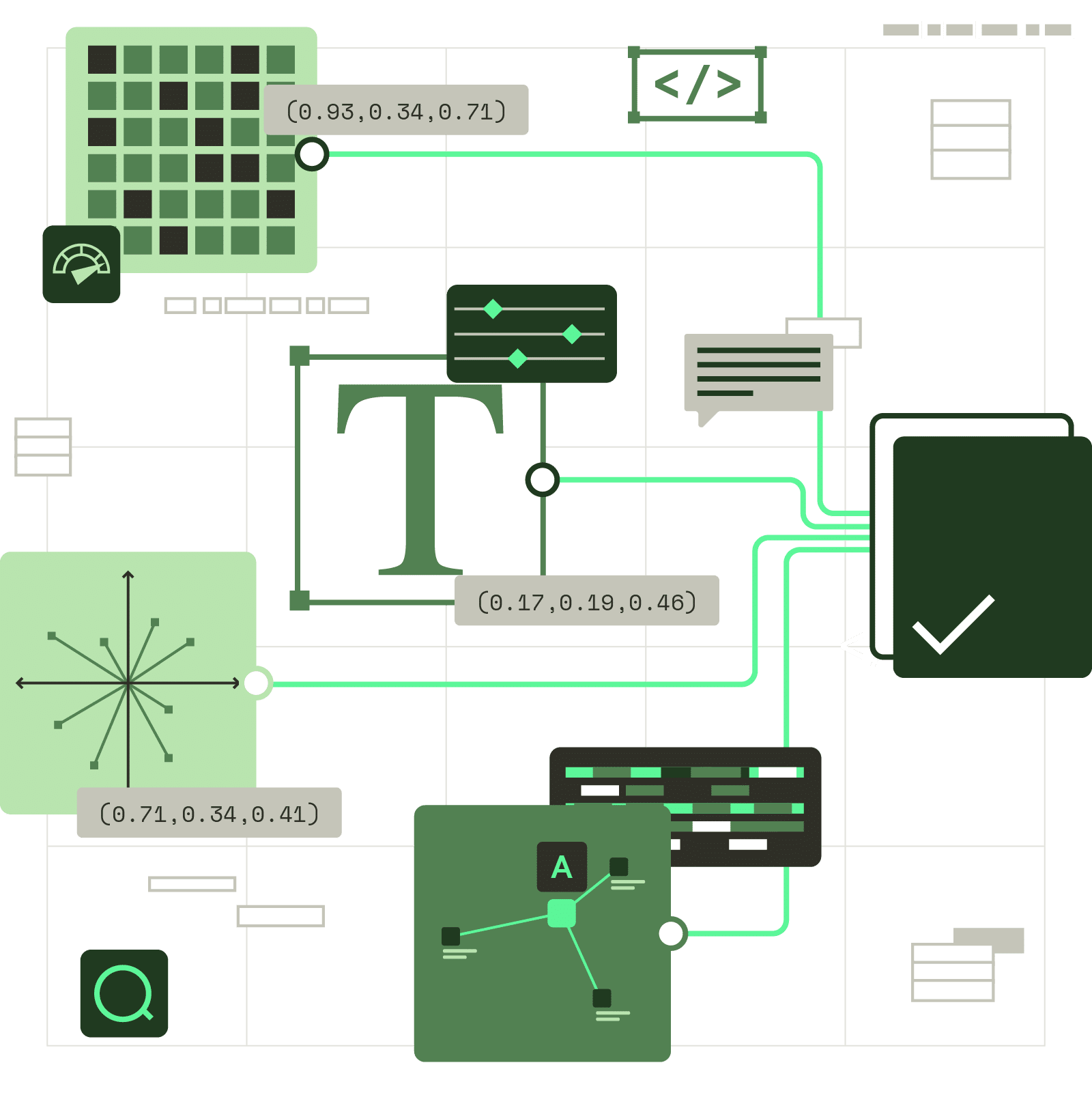
At the heart of Vespa is a simple principle: execute retrieval, ranking, and machine learning where the data resides. By moving computation to the data instead of moving data between specialized systems, Vespa minimizes network overhead, reduces infrastructure complexity, and delivers predictable performance at scale.

A unified architecture for retrieval, ranking, machine learning inference, and real-time serving.

platform architecture

Architecture components

See how Vespa brings retrieval, ranking, machine learning, and real-time updates together in a distributed architecture. The cards below give you an overview of each component; follow the links for a technical deep dive.

  • Unified data model

    Store structured data, full text, vectors, and tensors in one schema, so you can retrieve, filter, and rank across them without stitching together multiple systems.

    Explore the unified data model →
  • Distributed serving

    Run retrieval, ranking, and machine learning where the data resides, with a shared-nothing architecture built for high throughput and predictable latency.

    Explore distributed serving →
  • Retrieval pipeline

    Combine lexical and vector search, filtering, structured retrieval, and passage search in a single query pipeline.

    Explore the retrieval pipeline →
  • Multi-phase ranking

    Apply lightweight ranking signals first, then more sophisticated models to the results worth examining more closely.

    Explore multi-phase ranking →
  • Machine learning inference

    Run ONNX, XGBoost, cross-encoders, and custom ranking functions alongside retrieval, without separate model-serving infrastructure.

    Explore machine learning inference →
  • Real-time updates

    Index new content and apply partial updates almost immediately, so applications can act on the latest available information.

    Explore real-time updates →

Deployment

Deployment & operations

See how Vespa applications are deployed, managed, and scaled in production. The cards below give you an overview of each capability; follow the links for more technical detail.

  • Application deployment

    Package document schemas, ranking logic, machine learning models, and configuration as one application that you can deploy consistently across development, testing, and production.

    Explore application deployment →
  • Multi-cluster architecture

    Run multiple content clusters in one application, so you can index, scale, and tune different datasets and workloads independently.

    Explore multi-cluster architecture →
  • Multi-cloud deployment

    Use the same application model across public cloud, private infrastructure, and hybrid environments to support migration, disaster recovery, and global expansion.

    Explore multi-cloud deployment →
  • Horizontal Scaling

    Add nodes to increase storage, indexing capacity, and query throughput as your application grows, without redesigning it.

    Explore horizontal scaling →

RElated content

Solution guides

The Technical Deep Dives explain how the platform is built. The resources below show how Vespa's architectural capabilities can be applied to common AI search patterns and implementation challenges.

  • The RAG Blueprint

    A modular application template for designing, deploying, and testing production-grade RAG systems.

    Read more
  • Visual retrieval

    Enhance multimodal search by combining image and text queries for more comprehensive results.

    Read more

Learn with Vespa

Learn how to build search, recommendation, and RAG applications with Vespa through a free, self-paced course that combines hands-on exercises with links to the documentation.

Ready to build your AI search workflow?

Whether you're evaluating Vespa Cloud or planning a self-managed deployment, we'd be happy to discuss your architecture, answer technical questions, and help you get started.