Engineering principles
Distributed serving is more than simply partitioning data across servers. Vespa is designed around a set of architectural principles that keep AI applications fast, scalable, and operationally simple as data volumes, query traffic, and ranking complexity grow.
Select the arrow to explore how distributed serving reduces infrastructure complexity while maintaining predictable performance.
- Compute Where the Data Resides
- Shared-Nothing Architecture
- Independent Scaling
- Predictable Latency
- Distributed Ranking
- Continuous Freshness
- Built-in Resilience
- Unified Query Pipeline
Compute where the data resides
Keep expensive computation close to your data.
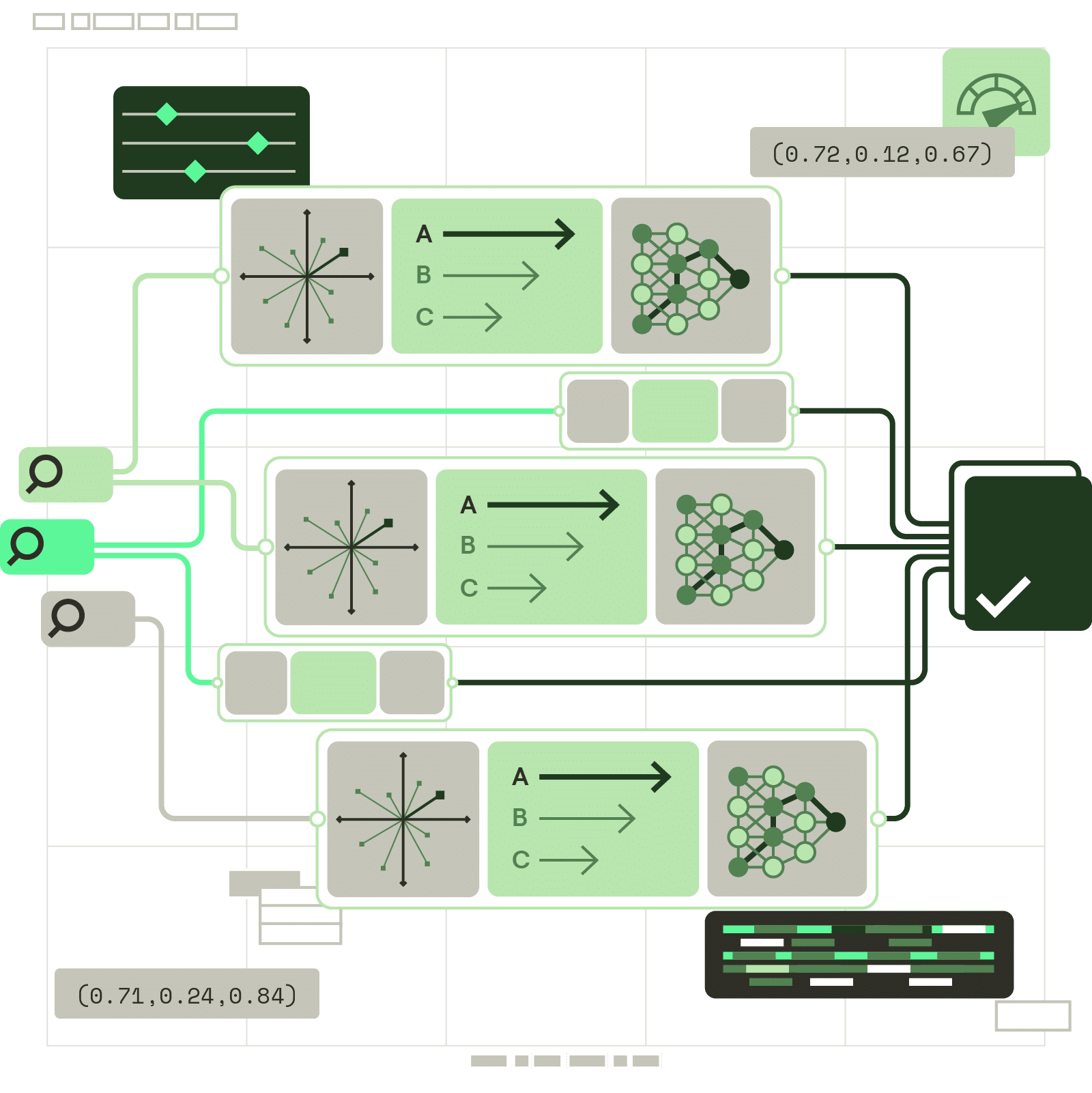
Moving large candidate sets between retrieval, ranking, and inference services increases latency, consumes network bandwidth, and adds operational complexity. Vespa instead executes ranking expressions, tensor operations, and machine learning models directly on the content nodes storing the relevant documents.
Only the strongest candidates are transferred for later ranking stages, allowing complex retrieval pipelines to evaluate large datasets without repeatedly moving document features or embeddings across the network. The result is better resource utilization, lower latency, and a serving architecture that scales naturally as ranking models become more sophisticated.
Shared-nothing architecture
Every Vespa content node operates independently with its own data, indexes, memory, and compute resources. Rather than relying on centralized storage or processing, queries are executed in parallel across the nodes holding the relevant data, allowing capacity to grow simply by adding more nodes.
This shared-nothing architecture eliminates centralized bottlenecks while scaling storage, retrieval, ranking, and machine learning together. The result is predictable performance, efficient resource utilization, and a serving architecture that continues to scale as data volumes and query traffic increase.
Scale data and traffic independently
Scaling AI applications isn't just about storing more documents. As query volumes grow and ranking models become more sophisticated, different parts of the serving architecture often require additional capacity at different times.
Vespa separates stateless query processing from distributed content serving, allowing each layer to scale independently. Teams can add query processing, storage, retrieval, or ranking capacity exactly where it's needed, avoiding unnecessary infrastructure while maintaining predictable performance as applications evolve.
Predictable latency at scale
Adding servers doesn't automatically deliver lower latency. Without careful query execution, distributed systems can simply introduce additional network overhead and unpredictable response times.
Vespa keeps latency under control by executing retrieval and ranking close to the data, limiting candidate sets before applying more expensive ranking stages. Because only the highest-ranked results are transferred across the network, applications maintain consistent performance even as datasets, traffic, and ranking complexity continue to grow.
Distributed multi-phase ranking
Modern ranking models are too computationally expensive to apply to every matching document. Vespa distributes ranking across multiple stages, performing the earliest ranking phases on the content nodes before returning only the strongest candidates for further refinement.
This allows applications to combine efficient large-scale retrieval with increasingly sophisticated ranking models, applying expensive computation only where it has the greatest impact on relevance while keeping query latency predictable.
Built for continuous change
Many AI applications depend on information that changes constantly, from product availability and recommendations to news, advertising, and enterprise knowledge. Waiting for offline index rebuilds quickly becomes a bottleneck.
Vespa supports real-time updates while queries continue to execute, allowing new and modified content to become searchable without interrupting serving. Freshness becomes part of the distributed serving architecture rather than a separate operational workflow, making it well suited to dynamic AI applications.
Resilience through redundancy
Distributed systems should continue serving even when individual nodes become unavailable. Vespa distributes and replicates data across content nodes so queries can continue using available replicas while reporting coverage information back to the application.
This provides high availability without introducing complex failover logic into the application itself. Maintenance, upgrades, and infrastructure changes can be performed while the system continues serving production traffic.
One distributed system for the complete query pipeline
Many AI architectures assemble separate systems for search, vector retrieval, ranking, feature serving, and machine learning inference. Every additional component increases network traffic, operational complexity, and synchronization overhead.
Vespa unifies the complete query pipeline within a single distributed serving architecture. Structured filtering, hybrid retrieval, ranking, tensor computation, inference, and real-time updates all execute within the same platform, reducing infrastructure complexity while improving performance and scalability.