
Context Engineering

From context engineering to relevant evidence

Context engineering manages what a model receives at each step: instructions, tools, memory, working state, and retrieved information. Effective context depends on selecting the right combination for the task.

Retrieval Engineering makes enterprise knowledge and stored agent findings usable within that context. It combines query understanding, retrieval, filtering, ranking, and evidence selection, balancing relevance and freshness with latency, scalability, and cost.

For agents, this happens throughout a task. A research assistant may identify a company, investigate a claim, compare reporting periods, and retrieve supporting passages—each requiring different evidence.

Vespa provides shared serving infrastructure for these workflows, giving developers control over how applications store, update, retrieve, and rank information.

ENTERPRISE KNOWLEDGE AND AGENT FINDINGS

A shared foundation for application context

Bring documents, business records, and other enterprise information into a common searchable layer. Preserve source references and metadata so applications can scope searches, apply access rules, and select useful evidence.

Agents can also publish findings and observations for subsequent retrieval. As shared context grows, each agent can retrieve what matters to its task instead of loading everything into its context window.

Enterprise information and agent-generated findings feed a shared Vespa serving layer. Applications query for ranked evidence and publish new findings through APIs. Application and framework logic manage orchestration, context assembly, and authorization policies.

BUILT FOR MULTI-STEP AI WORKFLOWS

Relevant at every step. Current as work progresses

Effective AI context depends on accurate evidence, current information, and responsive retrieval. Vespa brings these capabilities together to support multi-step tasks, shared agent findings, and growing workloads across applications.
Accuracy across multi-step tasks
An agent’s next search often depends on what it has already found. Missing evidence or confusing product versions can steer subsequent investigation in the wrong direction, adding searches, time, and model costs.

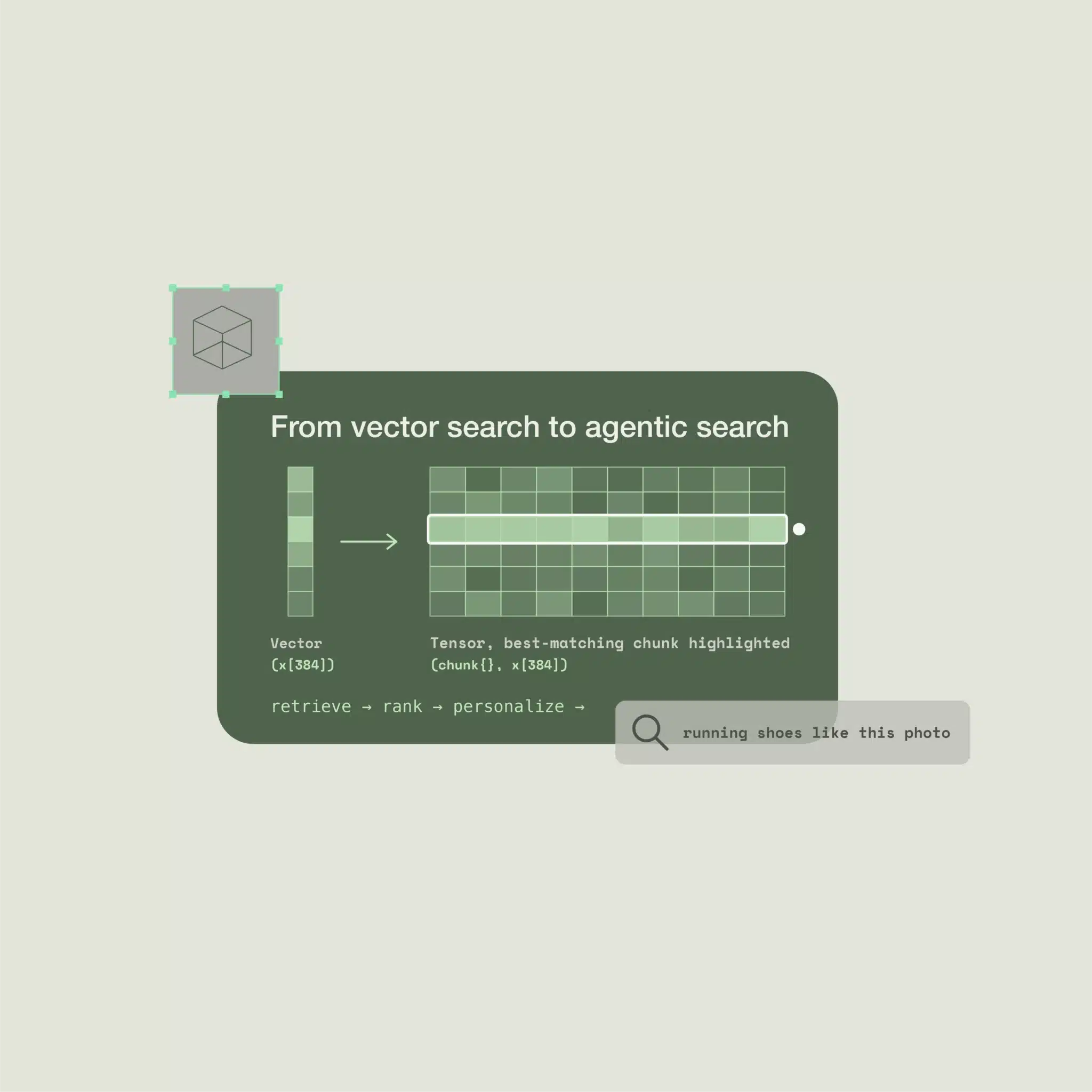
Vespa combines semantic retrieval, exact matching, structured filters, and programmable ranking to improve evidence selection. Multi-phase ranking applies sophisticated models selectively, helping agents stay on track while controlling computational cost.
Fresh information and shared findings
Business data changes while agents work. Vespa supports ongoing writes and partial updates, making changing information available to subsequent queries.

Agents can also publish findings for others to discover, with searches scoped by application-defined metadata such as tenant, session, or task. Each agent can retrieve relevant contributions as the investigation progresses, keeping shared knowledge useful without loading the entire context into every request.
Performance across applications
A single agent task can trigger repeated searches, while multiple applications generate concurrent retrieval workloads. Latency and computational costs accumulate as activity grows.

Vespa’s distributed serving architecture brings retrieval, ranking, and model inference into a common framework. Teams can support growing data volumes and agent activity while reducing data movement and the overhead of coordinating separate services across the retrieval workflow.

APIs, FRAMEWORKS AND AI PRODUCTS

Connect Vespa to your context workflow

Bring Vespa’s retrieval, ranking, and real-time updates into your context workflow through APIs, framework integrations, or as the shared infrastructure behind your AI product.

  • An API-based retrieval service

    Query Vespa with your constraints and ranking strategy, and receive relevant results for your application’s context. Expose tested retrieval strategies that agents can invoke as their needs change.

    Explore the query API
  • Within frameworks such as LangChain

    Use Vespa as a LangChain retriever or connect through APIs. Your application coordinates prompts, tools, memory, and model calls, while Vespa handles retrieval and ranking.

    Explore LangChain integration
  • Behind an agent or context product

    Build on a shared context layer that makes enterprise knowledge and agent findings searchable and current. Vespa serves ranked evidence while your product manages orchestration and the user experience.

    Explore retrieval for AI agents

Explore the platform behind better AI context

Bring retrieval, ranking, model inference, and real-time updates together in one platform. Discover how Vespa powers shared context for AI applications and agents at scale.

Frequently asked questions

Need more than a quick answer?

If these FAQs don't answer your question, there are several ways to continue:

Learn the fundamentals with our free online training at learn.vespa.ai.

Experience Vespa yourself with a free Vespa Cloud trial.

Watch the Getting Started with Vespa AI Search YouTube video

Contact our team to discuss your application or migration project.
When does a dedicated retrieval platform add value?
Simple lookups or built-in retrieval in your application may meet your needs. A dedicated platform becomes useful as requirements accumulate: multiple retrieval methods, custom ranking, frequently changing data, large collections, or many concurrent agent searches.
Vespa is designed for teams that need to engineer those capabilities together—and adapt them as their applications evolve.
How does retrieval engineering support context engineering?
Retrieval engineering determines which external information a model can access and how it selects, filters, and ranks it. It supports context engineering by providing relevant, up-to-date evidence that meets the application’s performance and cost requirements. Context engineering combines that evidence with instructions, tools, memory, and working state to support each step of the task.
Why isn’t vector search alone enough to provide useful context?
Semantic similarity is one signal of relevance. An application may also need exact product names, specific dates, availability constraints, authoritative sources, or customer preferences. Retrieval engineering combines vector search with keyword matching, structured filters, and ranking so the information returned fits the task. Vespa brings these capabilities together within a programmable retrieval workflow.
What changes when AI agents retrieve information repeatedly?
Each search can influence what an agent investigates next. Missing evidence, outdated information, or poorly ranked results can therefore affect subsequent decisions. Repeated searches also increase query volume, latency, and cost. Retrieval engineering addresses these demands by improving evidence selection, keeping searchable information current, and allocating ranking compute where it adds value.
How does Vespa integrate with context engineering frameworks and applications?
Applications can call Vespa through its Query API or use a framework integration such as the LangChain retriever. Requests specify the search, filters, ranking strategy, and relevant inputs; Vespa returns ranked information for the application to incorporate into context. This allows teams to coordinate instructions, memory, tools, and model calls while using Vespa to execute retrieval and ranking.
Can Vespa power retrieval behind an agent or context platform?
Yes. Vespa can provide a shared context-serving layer for enterprise knowledge and agent-generated findings. It combines storage, hybrid retrieval, programmable ranking, and real-time updates so applications can select relevant information for each task. Your product manages the user experience, orchestration, and context assembly, while Vespa serves the searchable information those workflows depend on.
How can multiple agents share context through Vespa?
Agents can publish findings and observations to Vespa, then selectively retrieve information contributed by other agents. Application-defined metadata can scope searches by tenant, session, or task, while ranking helps select useful evidence as the shared information grows. This supports collaboration without requiring every agent to load the entire shared context. Application logic remains responsible for authorization and coordinating the agents’ work.

Ready to build your AI context layer with Vespa?

Talk to our team about your application, data, and retrieval requirements. Explore how Vespa can help you deliver relevant, current context with the performance and scale your agents need.

Resources

Continue exploring

Explore related eBooks, technical deep dives, webinars, and guides to learn more about this topic.