Retrieval for AI Agents

AI agents transform how businesses operate, but the quality of agent outcomes is determined as much by their retrieval strategy as by the language model itself. Vespa executes the AI retrieval workflow, enabling reliable, scalable agentic AI.

AI Agents Need Better Retrieval

AI agents cannot compensate for poor retrieval the way people can. Unlike traditional search, where users reformulate queries, apply filters, and verify results, AI agents depend on retrieval that executes accurately, efficiently, and repeatedly throughout every stage of a task. Rather than issuing a single search, they may perform dozens or even hundreds of retrieval operations, refining queries and retrieval paths as new information emerges. Every retrieval influences the next, making retrieval quality fundamental to the agent's overall success.

The Retrieval Workflow

Every successful AI agent follows the same high-level pattern: it plans how to retrieve information, executes that retrieval, evaluates the evidence, and refines its approach as understanding develops. This iterative process is the AI retrieval workflow.

How Agents Interact with Retrieval

AI agents plan retrieval; they do not perform it. The agent determines what information is needed and how to search for it. The AI retrieval workflow carries out that plan by retrieving, ranking, filtering, and enriching the most relevant evidence. Separating planning from execution allows each layer to specialize, producing more accurate, efficient, and scalable AI applications.

AI Agent (plans the investigation)
Vespa Retrieval (executes the plan)
Understand the task
Execute the retrieval plan
Decide what to retrieve
Find the best evidence
Refine the retrieval strategy
Retrieve, rank, and infer
Evaluate evidence
Apply business logic and ML
Decide when sufficient evidence is gathered
Return ranked results

Why Vespa for AI Agents

Choose Vespa when your AI agents require:

  • Sophisticated retrieval strategies rather than a single search technique.
  • Accurate retrieval and ranking for reliable reasoning and decision-making.
  • Low-latency execution across repeated retrieval workflows.
  • Continuously updated data for trustworthy responses.
  • A unified retrieval architecture instead of stitched-together point solutions.
  • Production-scale performance for customer-facing AI applications.

Vespa Executes the AI Retrieval Workflow

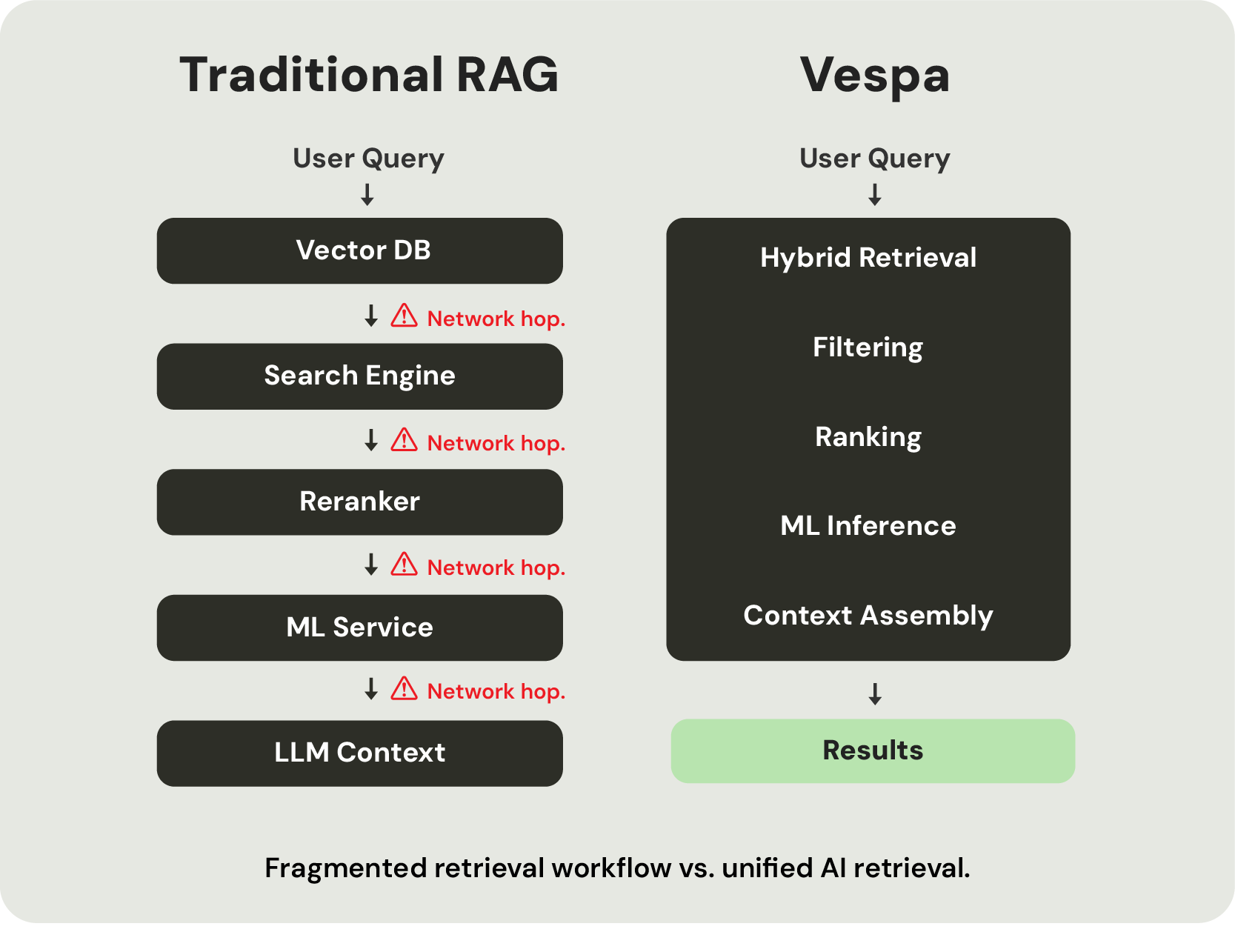
AI agents depend on retrieval executing accurately, efficiently, and repeatedly throughout every task. Vespa was designed for exactly this challenge. Rather than stitching together separate search engines, vector databases, rerankers, and inference services, Vespa performs retrieval, ranking, filtering, and machine-learning inference within a single distributed serving engine.

Because retrieval, ranking, and inference execute where the data lives, Vespa minimizes unnecessary data movement while maintaining predictable latency at scale. Continuous indexing keeps information fresh, while unified support for vector, lexical, and structured retrieval ensures every retrieval operation works from the same current state. Multi-phase ranking applies expensive machine learning models only where they improve the final result, maximizing both efficiency and accuracy.

The more autonomous an AI agent becomes, the more important the retrieval workflow becomes. Vespa is designed to execute that workflow efficiently, consistently, and at scale.

This architectural approach doesn't just simplify operations—it also delivers measurable performance benefits. Independent analysis from GigaOm highlights how integrated AI Search Platforms reduce infrastructure complexity, improve performance, and lower operational costs compared with fragmented retrieval architectures.

One Engine

Optimize the entire retrieval pipeline.

Many RAG architectures move data between vector databases, search engines, rerankers, and inference services before building context for the language model. Every additional service adds latency, cost, and operational complexity. Vespa performs retrieval, filtering, ranking, and machine-learning inference in a single distributed serving engine, delivering more accurate context with fewer moving parts and <100 ms latency required for large-scale AI retrieval.

Always Fresh

Better answers start with current information.

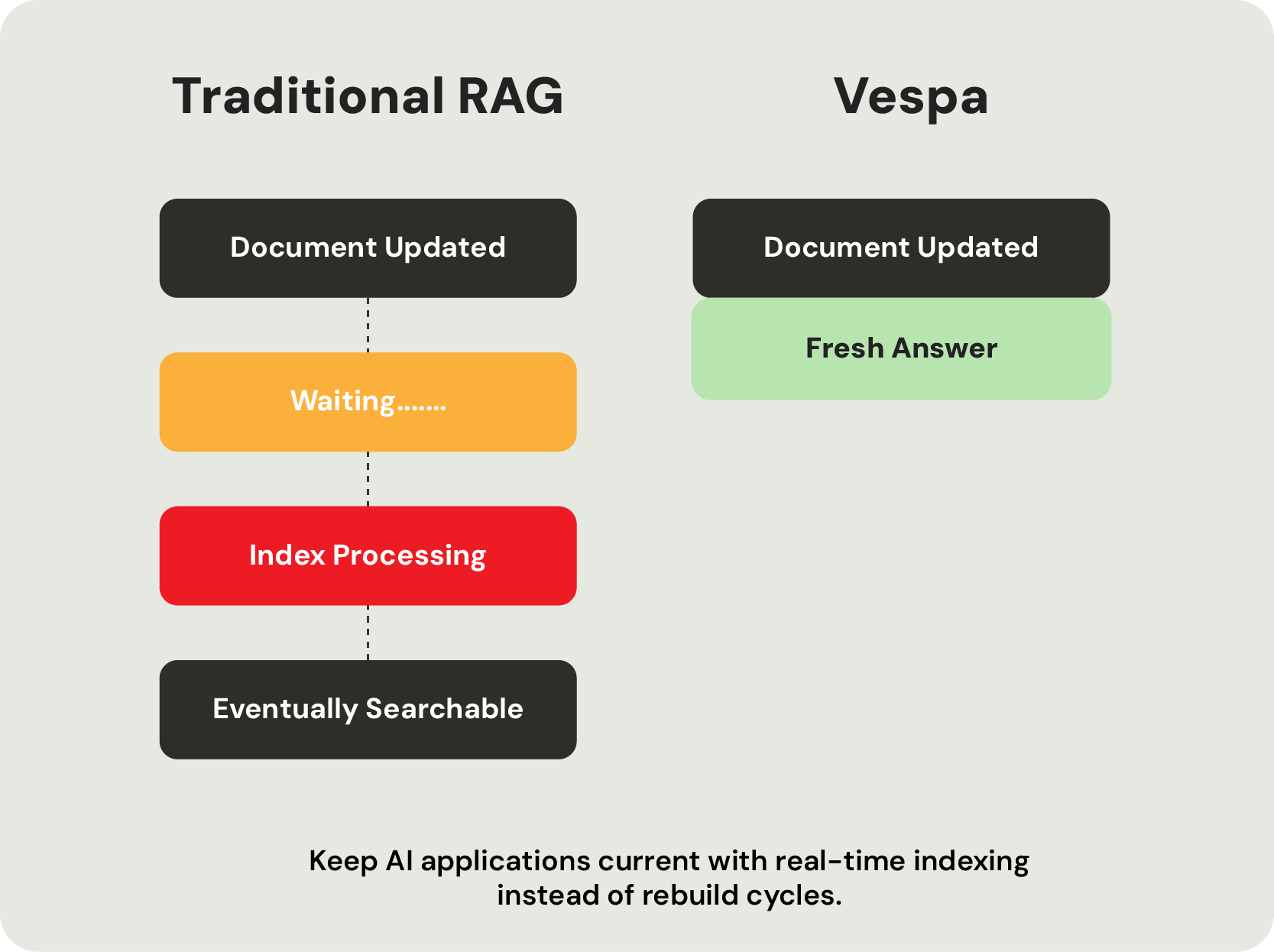
The quality of AI-generated answers depends on fresh retrieval. Documents, embeddings, user signals, and business data should become searchable immediately—not after an index rebuild or scheduled refresh. Vespa continuously indexes and updates data while serving live traffic, keeping RAG, agentic AI, search, and recommendation applications synchronized with the latest information.

High Performance at Scale

Keep AI retrieval fast as applications grow.

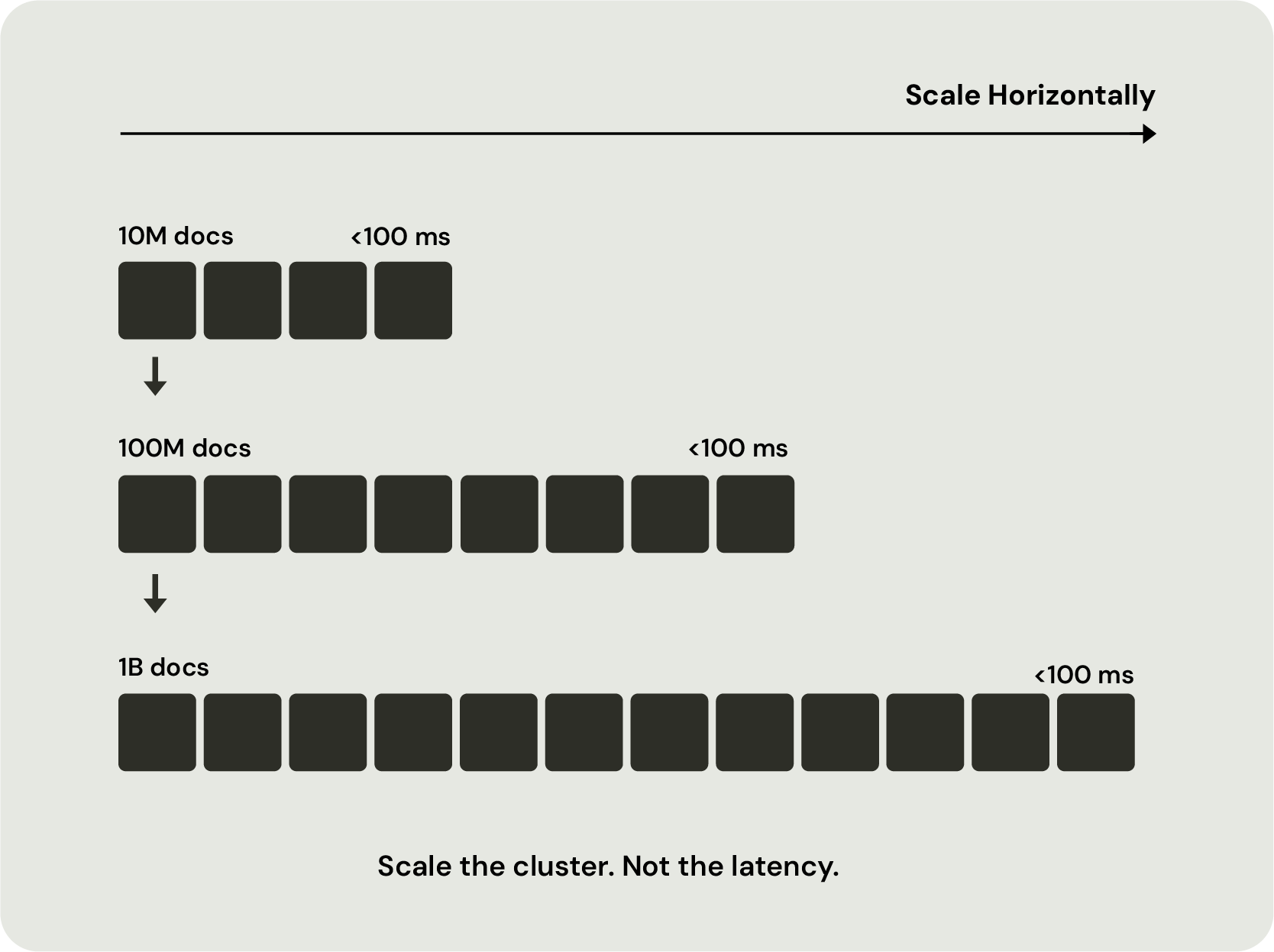
AI agents don't just perform more retrievals—they amplify every inefficiency in the retrieval architecture. Every network hop, data transfer, reranking stage, and inference call is repeated throughout the workflow, increasing latency, cost, and operational complexity. Vespa scales retrieval, ranking, and machine learning together within a single distributed serving engine, minimizing unnecessary data movement while maintaining high throughput and predictable latency as AI workloads grow.

We make AI work at Perplexity

Perplexity delivers millions of users accurate, cited answers by combining large language models with real-time AI retrieval. As retrieval quality becomes increasingly critical to answer quality, Perplexity relies on Vespa to retrieve, rank, and continuously update the context behind every response.

By combining hybrid retrieval, advanced ranking, machine learning inference, and real-time indexing in a single distributed serving engine, Vespa enables Perplexity to deliver fast, trustworthy answers at internet scale.

Explore the AI Search Platform

Learn how the Vespa AI Search Platform combines retrieval, ranking, machine learning, and distributed serving in a single architecture to execute the end-to-end AI retrieval workflow for large-scale AI applications.

Frequently asked questions

Need more than a quick answer?

If these FAQs don't answer your question, there are several ways to continue:

Learn the fundamentals with our free online training at learn.vespa.ai.

Experience Vespa yourself with a free Vespa Cloud trial.

Watch the Getting Started with Vespa AI Search YouTube video

Contact our team to discuss your application or migration project.
What is agentic AI?
Agentic AI refers to AI systems that can plan, reason, and take actions to achieve a goal rather than simply respond to a single prompt. Instead of generating one answer, an AI agent may gather information, evaluate alternatives, use external tools, and perform multiple steps before completing a task. This makes agentic AI well-suited to complex workflows such as research, customer support, software development, and business automation.
What is the difference between AI agents and human search?
Traditional search is an interactive process. People reformulate queries, apply filters, verify sources, and decide whether the results are relevant. AI agents perform these activities autonomously. They may execute dozens or even hundreds of retrieval operations, refining their approach as they gather new information. Because there is no human correcting mistakes during the process, retrieval quality becomes a critical factor in the overall accuracy and reliability of the agent.
How does Vespa support AI agents?
Vespa provides the AI retrieval workflow that powers AI agents. It combines retrieval, ranking, filtering, machine-learning inference, and real-time indexing into a single distributed serving engine, enabling agents to efficiently gather, evaluate, and refine information throughout a task.
By executing these functions where the data lives, Vespa reduces data movement, maintains predictable latency, and keeps information continuously up to date. This integrated architecture is designed for AI agents that repeatedly retrieve and evaluate information before generating a response or taking action.
How do AI agents communicate with Vespa?
AI agents communicate with Vespa through its standard query APIs. When an agent needs information, it sends a request describing what it is looking for. Vespa performs retrieval, filtering, ranking, and any configured machine-learning inference, then returns the most relevant results in a structured format for the agent to reason over.
This separation allows each system to specialize. The AI agent decides what information it needs and what to do next, while Vespa is responsible for efficiently retrieving and ranking the evidence that informs those decisions. As an agent investigates a task, it may repeat this process many times, issuing new requests as its understanding evolves.
How do AI agents decide where to retrieve information?
The AI agent determines what information is needed and which data sources or retrieval tools to use. Vespa is responsible for executing retrieval over the data it manages, combining lexical, vector, and structured search with filtering and ranking to return the most relevant results.
This separation allows each component to specialize. The agent plans the investigation and chooses the next retrieval step, while Vespa efficiently executes each retrieval request. As an agent investigates a problem, this cycle may repeat many times before it generates a response or takes action.

Ready to Build AI Agents That Scale?

Whether you're designing your first AI agent or evolving an existing retrieval architecture, we'd be happy to discuss your requirements, answer technical questions, and help you build reliable, large-scale AI applications.